Showing posts with label CCSS. Show all posts

Thursday, August 11, 2016

Product Revamp and Something New -Plus Something Free for You!

I love creating literature units to go along with the CCSS. Kids love traditional stories, so it's great to find ways to include these classic stories into lessons. But, the more units I've created, the more disjointed they started to feel. I looked at my TpT store, and saw that all of the covers looked so different.
Last year I participated in the TpT Summer Challenge group where TpT sellers were encouraged to revamp a project and give it a makeover. This year, I decided to do the same thing ... on ALL of my CCSS Literature units. I wanted to give them all a cohesive look. (To check them out on TpT, click on the picture).

Here's the finished product(s):


I am really happy with the way they turned out. So happy, that it inspired me to finally finish another product I've had in the works all summer.

I've had the framework for this unit created since June, but it just kept sitting on my desktop .... unfinished. Thankfully, nap time this week has been peaceful and allowed me to get down to work and finally put the finishing touches onto the product.
I'm really excited about this because it's going to pair nicely with one of the 3rd Grade Units we created this summer during curriculum writing. Take a peek:


One skill I wanted students to understand in this unit was character traits. But, in order for students to understand how to find character traits, they must first understand the foundation of character traits. Sometimes, students confuse outside traits, for example, what a character looks like, for an actual trait. Saying a character has brown hair is very different than saying a character is bossy. Below you will find an activity I created to help students with this foundational skill. This 10-page activity is available for free on my TpT store, so hop on over to download yours now! 


How do you use classic literature in your classroom? What are your favorites?

Tuesday, August 9, 2016

Little Red Riding Hood - Understanding Theme Using Speech Bubbles (Free Resource)

So, being a mom has gotten the best of me. Meaning, it's truly the best, but doesn't leave me much time for my other favorite pastime ... blogging! As a new school year approaches, I am trying to recommit myself to my blog.

This summer I spent some time working on writing curriculum with a team of third grade teachers. We looked at standards, and studied standards, and looked at more standards .... you get the idea. Our goal was to use backward design to help construct cohesive ELA units that will help our students grow as readers.
Our district is not currently using a purchased curriculum, so we, as teachers, craft our own units. It's a big job, but also allows for a lot of teacher input and passion.

I had so much fun when it came to the creative part of the units - picking out literature and creating engaging learning activities. One piece of literature we chose for a focus of the "Cultures Around the World" unit was Little Red Riding Hood. It's a great familiar folktale, and has many versions. I particularly love Lon Po Po, written by Ed Young.


One thing we really wanted students to understand was point of view as well as how to find the message of the story. For a third grader, that's a lot to think about! In an effort to scaffold their learning, we crafted lessons that would building upon their current knowledge in order to help them understand how stories can teach us lessons, and how we can learn a lot about characters based upon who is telling the story.

In order to build these foundations, lessons were crafted with whole group (teacher led) and guided practice sessions.


One thing I really wanted was to engage the students in creative activities so they could show their learning and have fun! I wanted the students to think about how each character would feel about the message of the Red Riding Hood story. 

Click HERE to get the speech bubble activity for free from my TpT store! 


Interesting in using Little Red Riding Hood to teach core reading skills? These are the books I love!

Text Suggestions: 
Little Red Riding Hood by Trina Schart Hyman
Lon Po Po by Ed Young 
Red Riding Hood Was Rotten by Trisha Speed Shaskan 
Petite Rouge by Mike Artell 

Interested in more activities to teach Little Red Riding Hood? Check out my CCSS Look at: Little Red Riding Hood.


Friday, July 17, 2015

Making My Masterpiece #tptsellerchallenge - just a little late :)

Two weeks ago was "Make Your Masterpiece" week for the TpT seller challenge. Well, I'm just a little behind. I was on vacation that week and have been teaching summer school since I've come home. But, I was determined to finish this set! I did, after all, start it last summer.
The other day I blogged about the set, and even offered a free download of the set as a preview. Today I finished editing and revising ... and it's uploaded! I definitely think it IS my masterpiece. It ended up being 250 pages long ... many more than I intended, but well worth it.
The set is for grades 3-5 RL Comprehension and can be used with any text! It has anchor charts, graphic organizers, and interactive notebook pages.


You can check it out on TpT by clicking the image above! 
Here's a preview! 


I'm going to put it on sale in my TpT store for the next couple of days to celebrate it's completion! 
And, a special thanks to those who offered to help edit before I published. I appreciate it! 


Tuesday, January 21, 2014

Cinderella and the Common Core - with a RL 4.9 Freebie

Ok, every once in a while the Common Core makes me so happy. Take RL 4.9 for example. 4th graders are expected to compare and contrast traditional literature from different cultures.

I'm not crazy. I know the standards can be overwhelming at times, BUT ... The reason I really like the standard is because I love Cinderella. And, that's as traditional of a story as you can get. Right?

I know I already posted about the Cinderella CCSS set I made for TpT, click here to check it out,  but this week I got brave and took some pictures of my anchor charts...EEK! They aren't pretty, but whose are? Ok, some of you probably have beautiful anchor charts ... not me.

To begin our lesson we read a very traditional version of Cinderella written by Charles Perrault.
 
As a class we filled out a story-map like graphic organizer (the students created their own and did it with me in their response journals). The was the "I Do" part of our lesson. We talked about characters, plot (to review summarizing), and theme. This really hits on RL 4.2.

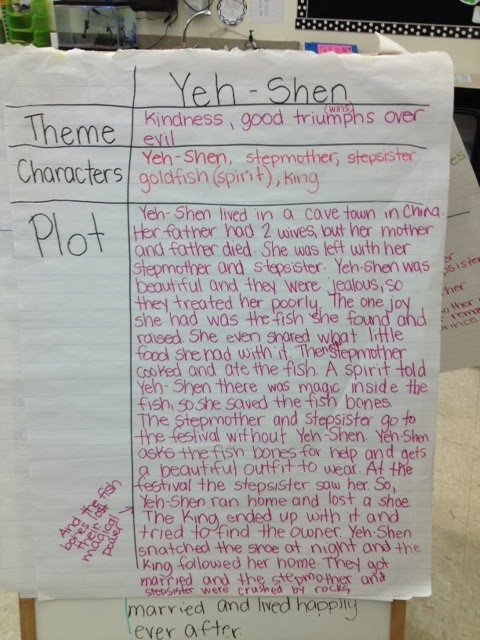
We then read one of the oldest recorded version of Cinderella, Yeh-Shen as retold by Ai-Ling Louie.
As a "We Do" activity, we again fill out our story map. This time I had the kids help me fill out the graphic organizer. They again created their own in their response journals. This again helped us review RL 4.2, which is an important building block for RL 4.9. In RL 4.9, students are expected to compare and contrast themes, plots, and patterns of events. So, they need a firm grasp on summarizing and theme before this can occur.

Here is the anchor chart I created. Again, I know it's not completely pretty, but it's what it is since I try to write quickly for the lesson. 


The next step was for us to look at the stories side-by-side. I find that this works the best by using another graphic organizer. My big thing is teaching my students how to create their own organizers. Handing them out to just fill in doesn't give them ownership on the process. When they draw them themselves, it's my hope drawing them becomes muscle memory. Here's the organizer we created to compare and contrast the two stories (using a mix of "I Do" and "We Do"):
My students did a really great job picking out details from the text. The key is to show them that they have to mention BOTH stories. Students tend to want to say things like, "They are different because Yeh-Shen had a fish for a fairy godmother". Instead, I want to visually show them they need to say, "The stories are different because Cinderella had a fairy godmother who granted her wishes, while Yeh-Shen had a pile of fish bones she used to ask wishes".

We used this graphic organizer to write an open-ended compare and contrast paragraph, similar to what they may need to do on a standardized test. It was definitely a LONG process and took MANY mini-lessons. However, I do think my students are really getting a handle on the skills. 

As an extension for the lesson I also split the kids into group by their reading level. I passed out other versions of Cinderella for them to read together. As a group they filled out another story map and did a compare/contrast chart using their story and the traditional version of Cinderella. Here are a list of other Cinderella stories and their levels:
 (Levels are approximated using the F&P conversion chart and Scholastic Book Wizard)
  • Cindy Ellen: A Wild West Cinderella by Susan Lowell - LEVEL M
  • Cinderella by Charles Perrault - LEVEL O
  • The Egyptian Cinderella by Shirley Climo - LEVEL O
  • The Korean Cinderella by Shirley Climo - LEVEL Q/R
  • Yeh-Shen by Ali-Ling Louie - LEVEL R
  • Smoky Mountain Rose by Alan Schroeder - LEVEL S
  • The Rough Faced Girl by Rafe Martin - LEVEL S
  • The Golden Sandal by Rebecca Hickox - LEVEL T
After reading together and creating their graphic organizers, students used the model of the open-ended response to write another compare/contrast. I then collected them to use as an exit slip and gauge student progress toward understanding the standard.

And just because I love all of you who read my blog, I created some anchor charts you could print out to display/fill in with your students. We have a poster maker at my school, which makes printing out large anchor charts so easy.

Here are the images of the file: (Click the images to directly download the PDF)
https://sites.google.com/site/readandblackandlearningallover/Compare%20and%20Contrast%20Texts%20RL%204.9.pdf?attredirects=0&d=1https://sites.google.com/site/readandblackandlearningallover/Compare%20and%20Contrast%20Texts%20RL%204.9.pdf?attredirects=0&d=1


https://sites.google.com/site/readandblackandlearningallover/Compare%20and%20Contrast%20Texts%20RL%204.9.pdf?attredirects=0&d=1https://sites.google.com/site/readandblackandlearningallover/Compare%20and%20Contrast%20Texts%20RL%204.9.pdf?attredirects=0&d=1


Some other things you may find helpful if you too are teaching this standard: 

Compare and contrast terms - click here for a free list of compare and contrast words to display for your students. This really helps them create their responses!

Visuals to help your students engage in your unit. The picture below shows one of my bulletin boards for our unit.These visuals are from my Cinderella unit and were printed using our school's plotter.

Wednesday, November 13, 2013

Poetry Practice with Casey

Oh, hey there! Yep, I'm still here. Yep, I still have a blog. Nope, I didn't forget about it.
Life got a little crazy at the start of this school year....and to be honest, I didn't put blogging at the top of my life. But, now I need to get back at it. So ... here is what we're working on in 4th grade:

Poetry!!

In looking at the CCSS, students have to do a lot more with poetry than just read it. Students need to understand poetry vocabulary, compare poetry to prose summaries, as well as visual representations. In looking at the suggested mentor texts for the CCSS, one of the suggestions was to read Casey at the Bat by Ernest Thayer. Here is a look at some of the things I'll be doing with the text:


Is this something you could do with your fourth or fifth graders? If so, click here for a copy of the activities.
As you can see, the first thing I'll be doing with my students is identifying key poetic elements in the text. We will especially focus on the imagery and tone of the piece, helping students to understand that these elements can happen in poetry just as in other literary texts.

Next we will be comparing the poetic version with the prose summary. I'm not sure my students even know what it means to read a prose summary, so that should be an interesting mini-lesson. Once we read and discuss both, we'll compare and contrast them in an open-ended response. I'll be using my compare/contrast words worksheet to help my students remember what words compare and what words are used to contrast. Click here to download it free from TpT.

Another thing I'm excited to do with this text is compare the poem to a visual presentation of the text. I think my students will really enjoy watching the cartoon version, especially since keeping their attention through the next week and a half could be tricky. I searched and found a Disney version on You Tube. Here is the link.

Check back later this week (or maybe weekend) for more about teaching figurative language (and ugh ... interpreting figurative language) to your students ...