Showing posts with label reading. Show all posts

Thursday, August 11, 2016

Product Revamp and Something New -Plus Something Free for You!

I love creating literature units to go along with the CCSS. Kids love traditional stories, so it's great to find ways to include these classic stories into lessons. But, the more units I've created, the more disjointed they started to feel. I looked at my TpT store, and saw that all of the covers looked so different.
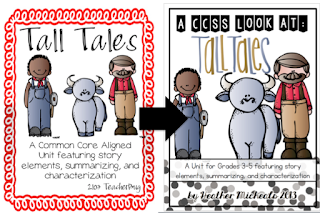
Last year I participated in the TpT Summer Challenge group where TpT sellers were encouraged to revamp a project and give it a makeover. This year, I decided to do the same thing ... on ALL of my CCSS Literature units. I wanted to give them all a cohesive look. (To check them out on TpT, click on the picture).

Here's the finished product(s):


I am really happy with the way they turned out. So happy, that it inspired me to finally finish another product I've had in the works all summer.

I've had the framework for this unit created since June, but it just kept sitting on my desktop .... unfinished. Thankfully, nap time this week has been peaceful and allowed me to get down to work and finally put the finishing touches onto the product.
I'm really excited about this because it's going to pair nicely with one of the 3rd Grade Units we created this summer during curriculum writing. Take a peek:


One skill I wanted students to understand in this unit was character traits. But, in order for students to understand how to find character traits, they must first understand the foundation of character traits. Sometimes, students confuse outside traits, for example, what a character looks like, for an actual trait. Saying a character has brown hair is very different than saying a character is bossy. Below you will find an activity I created to help students with this foundational skill. This 10-page activity is available for free on my TpT store, so hop on over to download yours now! 


How do you use classic literature in your classroom? What are your favorites?

Tuesday, August 9, 2016

Little Red Riding Hood - Understanding Theme Using Speech Bubbles (Free Resource)

So, being a mom has gotten the best of me. Meaning, it's truly the best, but doesn't leave me much time for my other favorite pastime ... blogging! As a new school year approaches, I am trying to recommit myself to my blog.

This summer I spent some time working on writing curriculum with a team of third grade teachers. We looked at standards, and studied standards, and looked at more standards .... you get the idea. Our goal was to use backward design to help construct cohesive ELA units that will help our students grow as readers.
Our district is not currently using a purchased curriculum, so we, as teachers, craft our own units. It's a big job, but also allows for a lot of teacher input and passion.

I had so much fun when it came to the creative part of the units - picking out literature and creating engaging learning activities. One piece of literature we chose for a focus of the "Cultures Around the World" unit was Little Red Riding Hood. It's a great familiar folktale, and has many versions. I particularly love Lon Po Po, written by Ed Young.


One thing we really wanted students to understand was point of view as well as how to find the message of the story. For a third grader, that's a lot to think about! In an effort to scaffold their learning, we crafted lessons that would building upon their current knowledge in order to help them understand how stories can teach us lessons, and how we can learn a lot about characters based upon who is telling the story.

In order to build these foundations, lessons were crafted with whole group (teacher led) and guided practice sessions.


One thing I really wanted was to engage the students in creative activities so they could show their learning and have fun! I wanted the students to think about how each character would feel about the message of the Red Riding Hood story. 

Click HERE to get the speech bubble activity for free from my TpT store! 


Interesting in using Little Red Riding Hood to teach core reading skills? These are the books I love!

Text Suggestions: 
Little Red Riding Hood by Trina Schart Hyman
Lon Po Po by Ed Young 
Red Riding Hood Was Rotten by Trisha Speed Shaskan 
Petite Rouge by Mike Artell 

Interested in more activities to teach Little Red Riding Hood? Check out my CCSS Look at: Little Red Riding Hood.


Monday, December 21, 2015

Back to Work.... And Holiday Comprehension

Well, I'm back to work, and if your school is anything like mine, we are facing some excited kiddos! Wrangling in their craziness can be tough this last week before Christmas. It's even worse here in the reading room. The last thing my students want to do is come to our room and practice their decoding, fluency, and comprehension. And the last thing I want to do is spend 35 minutes trying in vain to keep them on task. So, I wrote up a nonfiction article on holiday lights are created a few short, fun, generic nonfiction activities to keep them engaged.
Here's a little preview:


Download the whole set at my TpT store here!

Friday, July 17, 2015

Making My Masterpiece #tptsellerchallenge - just a little late :)

Two weeks ago was "Make Your Masterpiece" week for the TpT seller challenge. Well, I'm just a little behind. I was on vacation that week and have been teaching summer school since I've come home. But, I was determined to finish this set! I did, after all, start it last summer.
The other day I blogged about the set, and even offered a free download of the set as a preview. Today I finished editing and revising ... and it's uploaded! I definitely think it IS my masterpiece. It ended up being 250 pages long ... many more than I intended, but well worth it.
The set is for grades 3-5 RL Comprehension and can be used with any text! It has anchor charts, graphic organizers, and interactive notebook pages.


You can check it out on TpT by clicking the image above! 
Here's a preview! 


I'm going to put it on sale in my TpT store for the next couple of days to celebrate it's completion! 
And, a special thanks to those who offered to help edit before I published. I appreciate it! 


Monday, March 10, 2014

March Madness: A Reading Challenge

https://sites.google.com/site/readandblackandlearningallover/Ditch%20the%20Electronics.pdf?attredirects=0&d=1

If your students are anything like mine, they are in a bit of a reading slump. It's not that they aren't enjoying reading, it's just practicing for our state test has gotten them .... well ... bored to tears. If it was up to me, test prep would not be on the table. Alas, it's not up to me and I'm following the rules. BUT ... and I mean BUT, I still like to bend things, just a bit. Seriously, who wants to have students sit for 30 minutes a day doing mind numbing multiple choice?

UGH!

Enter March Madness and Math Madness .... (mini drum roll)

What exactly is March Madness? It is certainly NOT a basketball bracket! It IS a reading challenge. We have 6 classes of 4th grade on our team. Each class was challenged to READ! And read ... read ... read! Each class has a month to read as many books as possible (If you want a copy of the poster, just click on the picture to download it).
In order to get credit for books. Students must read books:
-In the month of March
-on their reading level

Then they take an Accelerated Reader quiz (a program our school pays for). You could also have them writing summaries to show what they've read or have parents sign a log. Either way, whichever class reads the most books in the month is the big winner.

I put a display in the hallway so students can track their progress as well as the progress of other classes. Once I approve their book, they write their name and book title on a Shamrock to hang in the hallway. We are losing .. big time! But, that's ok. Today I tried to get them all riled up to read. Will it work? Who knows?

We are also doing some ELA testing practice. I found some practice questions from old released items and books I've collected. Students are working in partners to answer questions and find text evidence to support their thinking. We have also been talking a lot about text taking strategies and ways tests "trick" us into picking answers that aren't correct. It's not the most exciting way to do it (and I'm open to anyone's suggestions!). BUT, one way I motivate them is to do some brain break activities at the end of our activity.  Have you ever heard of GoNoodle? Check it out! Its FREE and my kids love it.
https://www.gonoodle.com/ 
Their favorite are the Zumba videos. Though, today we did The Cupid Shuffle :)

Then, we have Math Madness...

It's basically math practice with a fun twist. We have to practice math questions like the ones that will be on our state assessment in two weeks. So ... I changed it up a little. I could not stand the idea of my kiddos sitting and doing packet after packet of problems. Instead, I split them into "teams". Each team has three students. The teams pick a question card from my pack (they are old released items from previous tests).

Questions all have different point values. They range from 1-4 points depending on difficulty and number of steps required to solve the problems. Each person on the team has to solve the problem on their own scratch paper and explain their answer. If each person does this AND gets it right, they earn the points to record on their points sheet.

That isn't the madness part of it. The madness is that once they do that, they may each shoot a basket to earn extra points for their team. You'll notice that the recording sheet is numbered. So are the questions. They record their points for a correct answer and any baskets made in the box that correlates to the question they just answered.

They are so excited to work together to get the correct answers. I split the groups up so they are all mixed ability. My math students who struggle are getting the benefit of hearing other students explain strategies. My high fliers are getting the benefits of being made to explain and verbalize their processes.

And, if that wasn't exciting enough ... I also give them GUM!

Here is my box of gum and questions. I do think they are enjoying it AND getting a lot of good review from the activities.

2 minus two weeks until we can go back to normal education. Where standardized testing doesn't rule the world ....


Monday, February 10, 2014

The Olympics are HERE!!

They only happen once every four years, so it's pretty exciting. For my fourth graders, it's really a big deal since they don't remember much about the last winter Olympics.

And sometimes, just sometimes, curriculum and current events line up just so nicely.

We just finished reading and exploring Greek Myths, and we are ready for a nonfiction unit.  I have to tell you, my kids loved that unit, so it is a really hard one to follow up. They were so interested and engaged ... and I didn't even have to stand on my head. (To supplement my unit I used my Greek Mythology Set on TpT).

Enter the Olympics ... originally created in .... ANCIENT GREECE!! Perfect.

On Friday we worked on crossing over from fiction to nonfiction. The great part about the transition was that we could talk about the Greek gods in reference to the Olympics. Did you know the Ancient Olympics we held in Olympia and honored the Greek God Zeus?
To get the kids excited about our new unit, we decided as a 4th grade team to have a little fun. Each classroom picked an event as their theme. My class picked hockey. Then, each classroom had to decorate their door with their theme. I let my kids take the reigns, and this is what they came up with: 


They aren't quite finished, but I think they are doing a great job. They also did an amazing job researching the rules of hockey. Each student picked a fact about the game and wrote it on a hockey puck. Obviously they aren't all finished! 
I usually also do another display on the wall outside my door featuring student work. So,  I decided to keep with the hockey theme. We were hitting idioms hard, and I wanted to have them show what they learned. So, I looked up some idioms commonly used in referencing hockey, and used them in a lesson. My students picked their favorite idioms we've learned and wrote the idiom and meaning on another hockey puck. We are a little puck crazy right now ...
I also put a description of the game of hockey outside the door with a lovely graphic by the extremely talented Nikki at MelonHeadz

I decided to make an event card for each of my teammates as well, and then printed them to our plotter. After I got that far, I decided I may as well make my document TpT worthy ... so I created 12 event cards as well as a graphing activity where students can pick and justify their favorite Winter Olympic event (click HERE to check it out). Here is our class bar graph: 
This is the exit slip they filled out. I tried to back them with construction paper to mimic the look of the Olympic rings.


Today we actually started digging into our nonfiction reading. Reading A-Z has some great nonfiction texts on the Olympics. I found a 4th grade level text titled The Olympics: Past and Present. We started reading it today, focusing on the structure of the book initially to gear us to better understand the text. This week we are really going to focus on RI 4.3: I can explained what happened and why in a historical, technical, or scientific text.
I usually like to put the graphic organizers I plan to use in my lesson plans. That way I can pick out the responses I want the students to give beforehand in order to guide their thinking. Otherwise I completely forget what I've picked out of the text. Does this happen to anyone else? 

The best part of today? Hearing cheers when I told my students the texts we would be reading ... SUCCESS!!! :)


Tuesday, January 21, 2014

Cinderella and the Common Core - with a RL 4.9 Freebie

Ok, every once in a while the Common Core makes me so happy. Take RL 4.9 for example. 4th graders are expected to compare and contrast traditional literature from different cultures.

I'm not crazy. I know the standards can be overwhelming at times, BUT ... The reason I really like the standard is because I love Cinderella. And, that's as traditional of a story as you can get. Right?

I know I already posted about the Cinderella CCSS set I made for TpT, click here to check it out,  but this week I got brave and took some pictures of my anchor charts...EEK! They aren't pretty, but whose are? Ok, some of you probably have beautiful anchor charts ... not me.

To begin our lesson we read a very traditional version of Cinderella written by Charles Perrault.
 
As a class we filled out a story-map like graphic organizer (the students created their own and did it with me in their response journals). The was the "I Do" part of our lesson. We talked about characters, plot (to review summarizing), and theme. This really hits on RL 4.2.

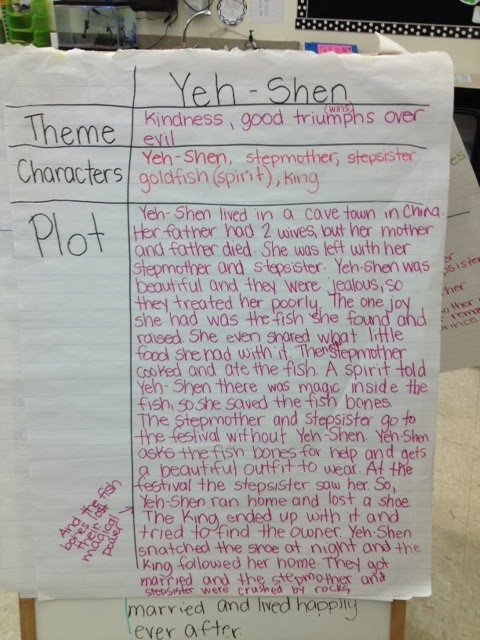
We then read one of the oldest recorded version of Cinderella, Yeh-Shen as retold by Ai-Ling Louie.
As a "We Do" activity, we again fill out our story map. This time I had the kids help me fill out the graphic organizer. They again created their own in their response journals. This again helped us review RL 4.2, which is an important building block for RL 4.9. In RL 4.9, students are expected to compare and contrast themes, plots, and patterns of events. So, they need a firm grasp on summarizing and theme before this can occur.

Here is the anchor chart I created. Again, I know it's not completely pretty, but it's what it is since I try to write quickly for the lesson. 


The next step was for us to look at the stories side-by-side. I find that this works the best by using another graphic organizer. My big thing is teaching my students how to create their own organizers. Handing them out to just fill in doesn't give them ownership on the process. When they draw them themselves, it's my hope drawing them becomes muscle memory. Here's the organizer we created to compare and contrast the two stories (using a mix of "I Do" and "We Do"):
My students did a really great job picking out details from the text. The key is to show them that they have to mention BOTH stories. Students tend to want to say things like, "They are different because Yeh-Shen had a fish for a fairy godmother". Instead, I want to visually show them they need to say, "The stories are different because Cinderella had a fairy godmother who granted her wishes, while Yeh-Shen had a pile of fish bones she used to ask wishes".

We used this graphic organizer to write an open-ended compare and contrast paragraph, similar to what they may need to do on a standardized test. It was definitely a LONG process and took MANY mini-lessons. However, I do think my students are really getting a handle on the skills. 

As an extension for the lesson I also split the kids into group by their reading level. I passed out other versions of Cinderella for them to read together. As a group they filled out another story map and did a compare/contrast chart using their story and the traditional version of Cinderella. Here are a list of other Cinderella stories and their levels:
 (Levels are approximated using the F&P conversion chart and Scholastic Book Wizard)
  • Cindy Ellen: A Wild West Cinderella by Susan Lowell - LEVEL M
  • Cinderella by Charles Perrault - LEVEL O
  • The Egyptian Cinderella by Shirley Climo - LEVEL O
  • The Korean Cinderella by Shirley Climo - LEVEL Q/R
  • Yeh-Shen by Ali-Ling Louie - LEVEL R
  • Smoky Mountain Rose by Alan Schroeder - LEVEL S
  • The Rough Faced Girl by Rafe Martin - LEVEL S
  • The Golden Sandal by Rebecca Hickox - LEVEL T
After reading together and creating their graphic organizers, students used the model of the open-ended response to write another compare/contrast. I then collected them to use as an exit slip and gauge student progress toward understanding the standard.

And just because I love all of you who read my blog, I created some anchor charts you could print out to display/fill in with your students. We have a poster maker at my school, which makes printing out large anchor charts so easy.

Here are the images of the file: (Click the images to directly download the PDF)
https://sites.google.com/site/readandblackandlearningallover/Compare%20and%20Contrast%20Texts%20RL%204.9.pdf?attredirects=0&d=1https://sites.google.com/site/readandblackandlearningallover/Compare%20and%20Contrast%20Texts%20RL%204.9.pdf?attredirects=0&d=1


https://sites.google.com/site/readandblackandlearningallover/Compare%20and%20Contrast%20Texts%20RL%204.9.pdf?attredirects=0&d=1https://sites.google.com/site/readandblackandlearningallover/Compare%20and%20Contrast%20Texts%20RL%204.9.pdf?attredirects=0&d=1


Some other things you may find helpful if you too are teaching this standard: 

Compare and contrast terms - click here for a free list of compare and contrast words to display for your students. This really helps them create their responses!

Visuals to help your students engage in your unit. The picture below shows one of my bulletin boards for our unit.These visuals are from my Cinderella unit and were printed using our school's plotter.